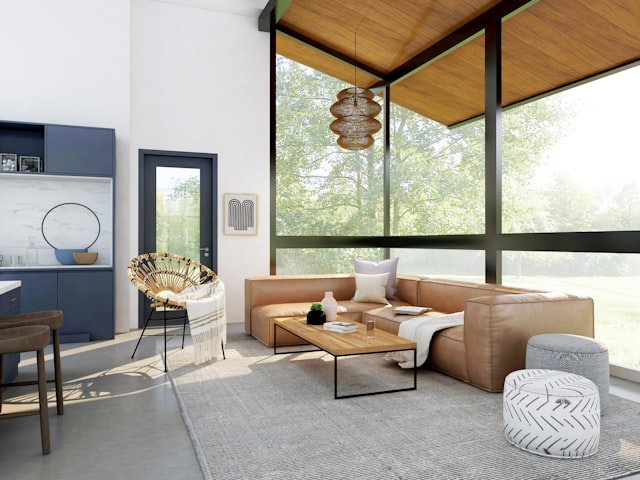
A practical guest post on flexible home design, smart organization, and operational efficiency for business-minded readers.
Modern Living Ideas for a More Flexible Home
A lot of people assume a home only needs to work well on the day they move in. The boxes get unpacked, the furniture finds a place, and for a while that feels like enough. Then work expands, routines shift, devices multiply, and the house starts revealing every weak decision made in a hurry.
That is where flexibility stops being a design preference and starts becoming an operational issue. In homes that now support remote work, side businesses, school schedules, deliveries, caregiving, and constant connectivity, bad layout choices create drag. Not dramatic failure, just a steady tax on time, attention, and patience.
Modern living is less about adding more stuff and more about making the space absorb change without losing order. The homes that age well are rarely the ones filled with the most features. They are the ones built around clear use, simple storage, and technology that supports the household without becoming another burden.
When the house starts slowing the business of life
The hidden cost of a weak setup shows up after onboarding, when the new routine settles in and the friction becomes obvious. That is when the printer has no dedicated spot, cables collect in temporary piles, the charging station migrates from room to room, and family members begin using whatever surface is open. It is not chaos in the dramatic sense. It is operational drag.
For business-minded households, that drag has consequences. Missed calls happen because devices are dead. Documents disappear because there is no reliable drop zone. A child’s school materials get mixed with work papers. A delivery sits where it blocks a walkway. These are small failures, but they compound fast, and the result is usually stress, liability, or lost continuity when someone important cannot find what they need.
Technology adoption makes the problem sharper, not easier, if the home does not support it. Smart locks, cameras, sensors, speakers, and app-controlled appliances can improve efficiency, but only when the physical environment is ready. Otherwise the household ends up with more logins, more alerts, and more confusion than before. This is where the difference becomes clear between average options and smart home lifestyle ideas that actually work long term.
The homes that perform best are the ones where clutter is reduced before it turns into a daily argument. That is not a decorative detail. It is a way of protecting trust in the system of the home itself. This is usually where buyers start looking at storage and layout choices more carefully in real-world conditions.
Judgment calls that separate useful from merely tidy
Flexibility sounds simple until you have to choose what gets built in, what stays mobile, and what should never be given permanent space. The best decisions usually come from understanding what the household actually does under pressure, not what looks efficient in a plan on paper.
Storage should match behavior, not hope:
Most clutter problems begin with optimistic storage. People buy bins, shelves, and organizers as if the issue were volume alone. It is not. The real issue is whether the storage supports the way items move through the home.
If keys always land near the entry, that is where the landing zone belongs. If laptops are used in different rooms, charging should not be tied to one outlet in one corner. If household paperwork has a life cycle, from arrival to action to archive, that process needs a visible path. Good storage is less about hiding things and more about making the next step obvious.
A practical warning: if storage is too deep, too high, or too segmented, people stop using it. Then the overflow spreads across counters and chairs, and the home begins to look untidy even when there is technically enough space.
Tech should reduce effort, not create another maintenance queue:
Smart devices make sense when they remove repetitive work or tighten oversight. They do not make sense when they demand constant troubleshooting. A home that depends on apps no one remembers, automations no one can explain, or devices that fail whenever the network hiccups has simply traded one kind of inconvenience for another.
This is where continuity matters. A smart home setup should still function when the internet is weak, when a battery dies, or when the person who set it up is unavailable. That means choosing systems with a clear manual fallback and thinking about who in the house can actually manage them.
Trade-off matters here. A more advanced system may promise convenience, but it can also increase reliance on updates, vendor support, and user discipline. For a busy household, the right choice is often the one that stays understandable six months later, not the one with the longest feature list.
Trying to solve daily friction with more surfaces:
One of the most common mistakes is adding furniture before defining function. A console table, a sideboard, a bench with drawers, a desk in the corner, a second cart for supplies—each seems helpful on its own. Together they can create more landing zones than the household can actually maintain.
The better approach is to decide what the room must carry every day and what it only needs to hold occasionally. That is how you avoid the slow creep of operational clutter. In a house where work and life overlap, every extra surface becomes a place for paper, devices, and unfinished tasks to accumulate.
- Choose fewer, better-defined drop zones.
- Keep shared items visible enough to find, but not spread across open surfaces.
- Build one backup process for power, charging, or access in case the primary system fails.
A more flexible setup, built in stages
The right sequence matters. If you reorganize randomly, you only make the mess harder to read. Start with how the household moves, then decide what should live where, then layer in the technology that supports it.
- Map the zones that already exist in practice. Look at where people enter, where they pause, where they work, and where they dump things when they are tired. Those informal patterns are usually more honest than any floor plan.
- Assign one job to each key area. An entry zone may handle keys, bags, and mail. A work zone may handle charging, notes, and files. A utility zone may handle tools, returns, and spare items. The point is not perfection; it is fewer conflicts between uses.
- Adopt technology only after the room is organized enough to support it. Smart lighting, cameras, and connected appliances work better when they are not compensating for poor storage, unclear ownership, or constant visual clutter.
Flexibility is really about continuity under pressure
The most useful homes are not the ones that stay unchanged. They are the ones that can absorb a new job, a new device, a new family routine, or a period of stress without forcing everyone to renegotiate the entire space. That is why layout, storage, and technology should be treated as part of household operations, not as separate design decisions.
In plain terms, when a home works, people stop talking about the house and start living in it. When it does not, every small task becomes a negotiation with the environment. That difference shapes trust, mood, and even how well a household handles unexpected demand.
A home that can keep up
Modern living does not require a showpiece home. It requires a home that can handle change without creating new messes every time the routine shifts. That means storing things where they actually get used, choosing technology that supports the household without becoming a burden, and resisting the urge to solve everything with more stuff.
The uncomfortable truth is that flexibility often comes from subtraction. Fewer weak points. Fewer improvised fixes. Fewer places where the household has to remember a workaround. If the space is built for continuity, the everyday pressure drops. If it is not, the cost shows up slowly, then all at once.